Tuesday, 1 September 2015

Book Review: A HUMAN GAZE

Harsh Mander's new book Looking Away: Inequality, Prejudice and Indifference in New India talks about the growing inequality and the lack of compassion amongst the rich for the poor in India. Darryl D'Monte reviews the book which despite its candidness about the grim realities offers a message of hope and promise.

01 September 2015 -
Without putting too fine a point on it, the images of Indrani Mukerjea, who has allegedly murdered her own daughter, reveal a somewhat different plot than what has so far appeared in most of the media.
She is usually portrayed in a sleeveless top with a plunging neckline, holding a glass of wine or a cocktail. The backdrop is usually one of a bar, with its neon-lit garishness betraying more than a hint of hedonism.
The Times of India has likened her to a female Gatsby – someone who came out of nowhere, had nothing much to show for herself apart from her sultry looks, and yet catapulted herself to the highest echelons of  society through relentless self-promotion.
The few images of her slain daughter, Sheena Bora, indicate someone who shares a likeness with her estranged mother. Indrani’s husband Peter has been at the top rungs of the media and has endowed her with the highest profile that any parvenu could hope for. 
Indeed, he was the CEO of Star TV, which is owned by the world’s most ruthless media mogul, Rupert Murdoch. Star introduced India to a new world of glitzy entertainment just as the country liberalised its economy in the early 1990s. No wonder that critics have called the entry of Star the “Murdochisation of the Indian media”.
I wondered about l’affaire Mukerjea after putting down Harsh Mander’s new book,Looking Away: Inequality, Prejudice and Indifference in New India. The media may carry image after image of the bold and beautiful in daily newspaper supplements and late-night shows on TV news channels, but these party-goers and givers and others of their ilk have turned their backs on the rest of India or “seceded” as Arundhati Roy puts it.

Looking Away: Inequality, Prejudice and Indifference in New India, Harsh Mander, Speaking Tiger, New Delhi, 418 pp, 2015, Rs 495. Pic: Darryl D'Monte
Mander documents in an almost cold-blooded manner not only the terrible disparity this country has promoted but how, like Marie Antoinette, we have insulated ourselves from “Bharat” and averted our gaze.
India now has the fifth largest concentration of dollar billionaires, after the US and China; the third largest middle class after China and the US; and the single largest concentration of the poor. 
A few years ago, as I have noted earlier elsewhere, the annual UN Human Development Report introduced a “multi-dimensional poverty index” in collaboration with an Oxford-based institute, which showed that India had more poor people in absolute numbers in eight states than the 26 poorest sub-Saharan countries put together. Madhya Pradesh had the worst indices.
Mander notes how Amartya Sen and Jean Dreze refer to “revenues foregone” through policies and measures to benefit the private sector, which since 1991 has been bloated through LPG–liberalisation, privatisation and globalisation. In 2011-12, even during the so-called pro-poor policies of the previous Congress government and its president Sonia Gandhi, Rs 5300 billion of corporate taxes, customs  and excise duties were written off, a staggering 5.7 percent of GDP.
Of this waiver, just exemptions on diamond and gold imports – a dire necessity for our Marie Antoinettes -- were estimated to leave the country poorer by Rs 570 billion. This was twice the estimated additional cost of the much-maligned National Food Security law. 
As Mander observes, all hell broke loose over the food security bill, with conservative commentators like Surjit Bhalla and Gurcharan Das calling it daylight robbery. Das believed that cheap food would disincentivise work. The Economic Times characterised it as “money-guzzling”, citing an estimated annual burden of Rs 1,250 billion, figures which, the author says, have to be taken with a fistful of salt.
The author recalls that there was hardly any response from the same brigade when Narendra Modi, then Gujarat Chief Minister, made over 1,100 acres of fertile land to Ratan Tata to relocate his Tata Motors plant, which ran into rough weather in Singur, West Bengal. Tata got this at Rs 900 per sq metre, with dedicated power supply and water thrown in. This was in addition to a loan at 0.1 percent interest, repayable after 20 years. No wonder Tata publicly hugged the CM at the plant launch, much to the dismay of human rights activists opposed to Modi for presiding over the 2002 riots.
Modi also bestowed this largesse on the Ford car company and then on his perennial favourite, Gautam Adani, who invariably travels with him on his frequent trips abroad, almost as his Industries Minister. Adani was given land in the state at what Mander terms “shocking, rock-bottom” rates of between Re 1 to Rs 32 per sq metre.
We must echo what critics of the neo-liberal policy regimes which are sweeping across the world demonise the ‘Bretton Woods Sisters’ – the World Bank and International Fund. In a truly astounding case illustrating the yawning deficit in democratic governance of these two key institutions, the former is almost always headed by an American and the latter by a European (including the philandering Dominique Strauss-Kahn). Some countries are more equal than others.

Records Mander: “It is extraordinary that very recently, these very institutions have begun to acknowledge that they may have been wrong, and drastically so. ‘In far too many countries the benefits of growth are being enjoyed by far too few people. This is not a recipe for stability and sustainability.’ These are not the words of a Left-wing ideologue, but of Christine Lagarde, managing director of the IMF.
Mander continues, “She goes on, ‘Let me be frank: In the past economists have underestimated the importance of inequality. They have focused on economic growth, on the size of the pie rather than its distribution. Today we are more keenly aware of the damage done by inequality…It leads to an economy of exclusion, and a wasteland of discarded potential.
“She compares rising inequality in the US and India. ‘In the US, inequality is back to where it was before the Great Depression, and the richest 1% captured 95% of all income gains since 2009, while the bottom 90% got poorer. In India, the net worth of the billionaire community increased twelvefold in 15 years, enough to eliminate poverty in this country twice over.”
Mander quotes no less a person than former Finance Minister P. Chidambaram who stated how the tax-GDP ratio was 5.5 percent for direct taxes and 4.4 percent for indirect taxes, “one of the lowest for any large developing country and will not garner adequate resources for inclusive and sustainable development”. As the veteran rural affairs journalist P. Sainath alleged, Chidambaram did nothing to raise taxes but balanced his books by curbing expenditures in the social sector.
The virtue of Mander’s book is that it isn’t a diatribe against anti-people policies but an understated critique which is far more effective than a rant. What is more, he illustrates all these dismal policies with accounts of people in dire straits, which he gleaned from his peripatetic travels to the distant-most corners of his city, Delhi and the country at large.

These anecdotes yield reams of human experience which remain in one’s memory, much more than pure economic or sociological analysis would. For instance, at a Big Fight programme on NDTV with moderator Vikram Chandra which dealt with slum dwellers and their demonisation as unwanted migrants, he asked who in the audience had grandparents who were born in the capital. Only Chandra raised his hand; in other words, we are mostly immigrants ourselves.
At an Urban Age conference – organised by the London School of Economics and the Deutsche Bank – in Delhi in November 2014, this columnist presided over a session in which Mander took part. He recounted the answer a pavement dweller in the capital gave him when asked why he slept on the traffic divider in the centre of a busy road at night. Because the traffic fumes kept the mosquitoes at bay, he could catch a few winks.
The author also advocated that schools, which are only occupied for eight hours a day, could be turned into dormitories for homeless children at night. His book details his various encounters at relief camps for riot victims and other vulnerable people throughout the country. He even spent a night at a camp in Ahmedabad after the riots and is honest enough to mention that the single sojourn made him physically sick for several days.
Mander has written a remarkably candid and penetrating book which deserves to be widely read. It isn’t, as might be imagined, a dirge, rather a message of hope and promise. It could well be prescribed as compulsory reading not only for sociologists and anthropologists but, even more urgently, by economists and business school students, those who otherwise espouse the market without questioning it. The hope then is that we will then not simply turn away, but confront what we see.
Darryl D'Monte
01 September 2015


Monday, 31 August 2015

Looking At, Rather Than Away


I approached this book with some trepidation. I imagined it would be a diatribe against the ruling elite and it would be laborious to plough through.
I should have known better; Mander, as his regular columns show, has a light touch. He is never pedantic and fleshes out his understated criticism of the way things are with human anecdotes. Every point is illumined by one or more cases, all poignant and revealing in a way which academic analysis can’t provide.
Very early in this book, he questions the Tryst with the Market, a different destiny that Pandit Nehru would never in his wildest dreams have imagined. The middle and upper classes are getting seduced by the message Greed is Good, and the rest can go to hell.
A mall is a pretty good exemplar of this tendency, which Arundhati Roy has called the “secession” from the rest of India. When Mumbai opened its first, it was thronged by thousands, even the unwashed, who came in droves to experience the wonder of goods in an air-conditioned, sanitised environment – often foreign – in such a brazen, unprecedented display. They caused traffic jams.
The catch was they came, they saw but were not conquered enough to reach for their wallets. This wasn’t what the promoters planned. So they introduced an interesting innovation: only people with cell phones or credit cards would be admitted into it. Some people are more equal than others.
Poverty is violence
Ela Bhatt in a 2013 NDTV programme showcasing the greatest living Indians asserted that “poverty is violence…perpetuated with the consent of society”. Mander regrets that NDTV chose to celebrate its silver jubilee with this show by including tycoons like Mukesh Ambani “and numerous popular film and sports stars … [that] lead opulent lifestyles and do little public service.” I wonder, in retrospect, whether Ambani had already loaned the channel Rs 400 crores two years ago.
Mandar’s theme is clear from his title and it is reminiscent of Katherine Boo’s illiant exhumation of a single Mumbai slum: Beyond the Beautiful Forevers. The reference is to a hoarding advertising marble blocks for the homes of the ultra-rich, which obscures the grim conditions in the shanty immediately behind it.
Roy, in essay titled “Listening to Grasshoppers”, traverses not her well-trodden Naxal territory but the “the most successful secessionist struggle ever waged in India – the secession of the middle and upper classes in a country of their own, somewhere in the stratosphere where they merge with the rest of the world’s elite… [this] vast middle class, punch drunk on sudden wealth” has created a kingdom with “its own newspapers, films television programmes, morality plays, transport systems, malls and intellectuals”.
The journalists’ grapevine has it that a former editor of the Times of India was asked by media students why the paper didn’t carry enough about child malnutrition. He replied that the Times’ readers didn’t suffer from it.
Legitimizing inequality
Mander lists three normative systems which legitimize inequality in our society. The first is the caste system. This reviewer can admit that till he went abroad as an undergraduate, he thought that the caste system had disappeared. At a noisy Cambridge Union debate, when an Englishman harped on it, I declared, to loud acclaim, “You should be castrated!”
In his excellent 1998 book, Words Like Freedom, Siddharth Dube enlightened me that in a typical UP village, boys from landless Dalit families can’t even enter the classroom; they have to bring their own mats to sit outside. When a Thakur’s wife accidentally fell into the village well, and some Dalits fished her out, her first response was to rush home to have a bath.
Mander’s second is the British class system, meant for people with old wealth: the schools’ names, such as one I went to, can trip off people’s tongues. On 26 August, the ToI carried a “top” edit page article titled “Schooling without learning”, alleging that the Right to Education “destroys private schools and destroys standards in public schools”. The old boy/girl network is alive and kicking.
The third is the “celebration of conspicuous consumption associated with the collapse of the socialist world and the rise of neo-liberal, market-led growth…This is the new India which celebrates when India’s richest man, Mukesh Ambani, follows up his gift of a 60-million-dollar jet-plane to his wife with the most expensive residence in the world, a 27-storey house for a family of four, built at an estimated cost of 1 billion dollars, which boasts three helipads, four storeys of handing gardens, and a staff of 600 domestic helpers.” In a city where six out of every ten people is homeless, this verges on the obscene.
According to the National Council for Applied Economic Research (NCAER), not a champion of socialist ideology, only 12% of the population can comprise the middle class. Mander quotes the CEO of Oxfam India to point out that just a 1.5% wealth tax on 65 of India’s uber-rich could lift an astounding 90 million out of poverty. If the country could reduce inequality by just over a third, it could eliminate extreme poverty. However, as anchors on business channels are asking these days, why hasn’t the NDA reduced corporate taxes, as promised in the last budget?
The most telling data on India’s inequality – apart from the recent, suppressed, Socio-Economic Survey, which encompasses caste – is from, surprisingly, the Credit Suisse Global Wealth Databook 2014. Since 2000, the share of wealth of the richest 1% in the country has been rising, in contrast to the rest of the world, and it now owns nearly half the country’s wealth. The wealth share of the top 10% as increased by a tenth since 2000, which is when the toxic triad known as “Liberalisation, Privatisation & Globalisation” or LPG kicked in here.
Mander’s book should be prescribed reading in universities across the country. The publishers ought to have included an index, so people can check on each vital piece of information. Hopefully, they will do in the next edition.
And some unsolicited advice: he could consider bringing out another version which has b&w photographs and captions instead of text, somewhat on the lines of John Berger’s co-authored classic, A Seventh Man (1975) which dealt with (the proportion of) migrants to Europe at the time. It would remain a lasting testament to our less fortunate brothers and sisters.
http://thewire.in/2015/08/29/looking-at-rather-than-away-9506/


Thursday, 27 August 2015

How India Can Cut Short-term Carbon Emissions 70%


How India Can Cut Short-term Carbon Emissions 70%
Darryl D'Monte, August 24, 2015

As India works on its voluntary commitments to reducing its greenhouse gas (GHG) emissions, Indian experts have explained how the country could cut its carbon emissions from short-lived climate pollutants by nearly three-fourths using low-cost methods and, in the process, transform the lives of the poor.

The US, EU and China are among the major countries which have declared their commitments; the global community is waiting to see what India does.

India has already indicated that it is going to take minimalist steps as regards its “Intended Nationally Determined Contributions” or INDCs (as they are known in United Nations negotiations), as environment minister Prakash Javadekar said. India will take a further cut on its emissions intensity–the amount of energy used to produce a unit of GDP–from 20-25% on 2005 levels to around 35-40%.

To an extent, current science on climate change justifies this policy, as speakers observed at the sixth annual climate conference, organised by the Tata Institute of Social Sciences (TISS) in Mumbai, on equity in the forthcoming UN climate summit in Paris this December.

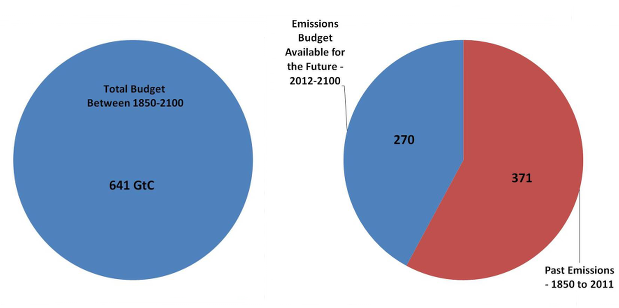
TISS has developed a “carbon budget” for both industrial and developing countries, which provides a clear glimpse of what each is entitled to emit in an equitable framework.

The total amount of emissions from the start of the industrial revolution in 1850 till 2100 is 641 gigatonnes of carbon equivalent (GtC, 1 Gigatonne = 1 billion tonnes), according to Tejal Kanitkar of the Centre for Climate Change at TISS.

If the world’s climate is not to spin out of control when mean temperatures rise by 2⁰C above 1850 levels, there is a total budget of 270 GtC till 2100, as against 371 GtC already emitted from that baseline till 2011.

monte_desk
Source: Tejal Kanitkar, TISS

Developing counties have only “spent” 97 GtC out of the 371 GtC so far.

Industrial countries have only 50 GtC to spend till 2100, while developing nations have 220 GtC left.

However, based on their INDCs made so far before Paris, rich countries will already exceed this budget by 2030 alone.

If the model developed by TISS with the Delhi Science Forum, which takes into account “historical responsibilities” or past emissions, is applied, rich countries can only spend 39 GtC till 2100.

If developing countries leave it to “business as usual” and commits to what “we think is reasonably possible”, Kanitkar says, a 2⁰C rise is inevitable.

But if they cut their emissions steeply, their development plans will go awry, what Kanitkar terms a “lose-lose situation”.

India’s energy options: What greater efficiency could do

While holding industrial countries responsible for putting the world’s climate – and consequently development – back in order, Kanitkar also believes there are tangible, quantifiable trade-offs in undertaking mitigation actions domestically.

“We can’t be cavalier about it – lots of homework is needed,” she says.

This can be taken further by examining India’s energy options. An aggressive pursuit of efficiency can be a win-win situation, according to Ashok Sreenivas of Prayas, a Pune NGO working largely on energy.

The potential value of saving electricity from appliances is Rs 2.50/kWh (per kilowatt hour, a unit of electricity).

 Buildings can be better designed. Improvements can be made in industrial processes, vehicle technology and agricultural pumps.

This requires imposition of standards, such as those introduced by the Bureau of Energy Efficiency. There can be incentives and penalties.  This will also create a market for energy-efficient processes and products.

Transport accounts for a tenth of India’s GHG emissions. There could be a shift from road to rail across the nation, greater use of public and non-motorized transport in cities and better spatial planning.

 These options will not only reduce GHG emissions but also reduce costs, improve mobility (and hence access to education, jobs etc.), reduce imports and, not least, improve air quality.

Renewable energy is relevant to India for reasons beyond reducing carbon emissions, Prayas states. It uses local resources, impacts the local environment and is price-effective in the long-term.

The government has announced aggressive plans – a capacity of 175 GW by 2022, asIndiaSpend previously reported.

India can tweak policies, such as allowing householders who install rooftop photovoltaic (PV) sets to earn revenue for the surplus electricity they provide to the grid. Such tariffs can be telescopic – they rise with every kWh sold to the electric supply undertaking, providing incentives.

This way, high-end consumers on the conventional grid pay for a high cost resource. In this case, there are no batteries required to store PV energy, making it cheaper and environmentally friendly.

How helping the poor could help India

As many as 800 million households have to make do with poor cooking fuels – a form of energy which is even more vital than electricity. This is both domestically polluting and damaging to the climate.

It also has severe health impacts, Prayas points out. As many as 1.5 million people die prematurely due to household air pollution. It causes 25 million disability-adjusted life years or DALYs — a measure of overall disease burden, expressed as the number of years lost due to ill-health or early death.

Women and young children are most affected in rural homes, while housewives and girls fetch most of the fuel.

The suspended particulate matter and soot generated by inefficient chulhas or cook stoves form a controversial meteorological phenomenon known as the Asian Brown Cloud. These also get deposited on the highest reaches of the Himalaya and the black particles on the snow absorb more heat, causing it to melt.

Apart from the switch to more efficient chulhas, there is a clear development case for rapid uptake of clean, modern fuels like liquefied petroleum gas (LPG)), electricity and biogas, Prayas believes.

Control of short-lived climate pollutants like aerosols or black carbon and tropospheric ozone can mitigate the impact of climate change, Chandra Venkataraman and two colleagues from IIT-Bombay point out.

These are not included under the Kyoto Protocol because their mitigation is perceived to yield no reward. However, they can trigger “radiative forcing”, which are changes in the atmosphere due to GHGs, thereby accentuating ocean level rise.

Reduction in these pollutants as well as CO₂ can arrest South Asian sea level rise by 31-50%.

When black carbon increases, it destabilises the atmosphere and can reduce rainfall.

The three IIT authors cite a 2015 study in Nature titled “Soot and short-lived pollutants provide a political opportunity” by two Americans and Veerbhadra Ramanathan from the Scripps Institution of Oceanography at the University of California at San Diego.

Ramanathan, who addressed an International Federation of Environmental Journalists congress in Delhi before the Copenhagen summit in 2009, is the world’s foremost authority on the Asian Brown Cloud.

The US authors believe that cutting soot and these pollutants will deliver tangible benefits and show Paris that collective action by the world is possible. After December, they believe, the demonstration of such action will bestow credibility on the UN diplomatic process in climate negotiations.

The emission sources by sector for GHGs differ vastly from those of short-lived pollutants in India, according to the IIT-B study. Thermal power stations and heavy industry contribute 65% of the country’s GHGs while homes are responsible for 53% of transient pollutants.

Other sources, which also differ greatly, are transport, agriculture and brick production.

Of the 53% contributed to the pollutants by homes, chulhas are mostly to blame, together with kerosene wick lamps. Burning crop residue accounts for 14%, while diesel and petrol vehicles account for another 13%.

A tractor-mounted machine can cut and lift rice straws, sow wheat into the bare soil and deposit the straw over the sown area as mulch (and help to retain moisture in the soil), the authors state.

This reduces the time to sow wheat without burning the rice-straw residue. However, this technology doesn’t necessarily increase productivity or profits. It calls for regulation to curb residue burning and policy support for technology adoption.

There are technologies to switch to more efficient brick kilns, designing them in zigzag lines, rather than a conventional trench. At present only 2% of the country’s kilns employ this process and this, once again, calls for a policy prescription.

Bricks can also be fashioned from fly ash, waste from coal-fired power stations, without firing them. Only 12% of the nation’s fly ash is currently used for this purpose.

Replacing traditional technologies could make India lean and clean

Short-lived pollutants are generated by diverse sectors, using traditional technologies with low energy-efficiency and high emissions in homes, farms and brick production.

Biomass chulhas, kerosene wick lamps and crop residue burning contribute 65% of these pollutants’ emissions, while diesel vehicles alone add 10% of these emissions, amounting to 3,800 teragrammes of carbon dioxide equivalent or Tg CO2 eq (1Tg=1 million metric tonnes) per year.

Mitigation actions using currently available technologies can mitigate 70% of present-day emissions from all these sectors.

The authors ask whether such domestic actions to curb emissions from short-lived pollutants will qualify under the UN climate negotiations as voluntary “common, but differentiated responsibilities and respective capabilities”.

A survey of 73 households in Raikhel village in the drought-prone Marathwada region of Maharashtra by Anjali Sharma and Tejal Kanitkar of TISS in 2014 found that 90% used only one stove.

Almost a third of the stoves were used to heat water; 35% had no exhaust mechanism, while 40% were located outside the home.

Half the households purchased firewood, given a landscape which is being increasingly deforested. The use of farm waste was low because it was seasonal.

The TISS researchers stressed the benefit of switching to LPG, if homes could afford it. The drudgery of collecting firewood and indoor pollution were important factors which male-headed households didn’t consider.

As speakers at the TISS conference emphasised, while India has to demand greater contributions by industrial countries at Paris, along with funds and technologies for developing countries to mitigate catastrophic climate change, India can voluntarily cut its emissions with such low-cost methods, which are entirely in its enlightened self-interest and vital to its development progress.


(D’Monte is Chairperson, Forum of Environmental Journalists of India.)

Note: The headline and copy has been updated.


http://www.indiaspend.com/cover-story/how-india-can-cut-short-term-carbon-emissions-70-11432


Monday, 17 August 2015

Paris summit: India should put the heat on rich nations

  • Darryl D’Monte
  • | 
  • Updated: Aug 12, 2015 


It came as a shock to those who recently attended the annual climate conference organised by the Tata Institute of Social Sciences (TISS) in Mumbai to learn that there were only some 20 days left before India submitted its commitments to the UN global summit, culminating in Paris this December.

By now, pledges have been made by major players, barring this country.
Together with China, India was being demonised as the problem big polluter — the world’s largest after China, the US and the EU. But China has committed, proactively, to peak its greenhouse gas emissions by 2030 and reduce its carbon intensity — the amount of carbon dioxide emitted per unit of GDP — by 60-65% by then. India is being seen, in former environment minister Jairam  Ramesh’s summation at the 2014 TISS conference, as “the last man standing in Paris”.
India is scaling down its pre-summit commitment to a ‘minimalist’ offer, which will probably ratchet up its pre-Copenhagen summit pledge to cut carbon intensity by 20-25% by 2020, based on 2005 levels. It may raise this to 35-40%.
At this year’s TISS meet, Meena Raman from the Third World Network in Malaysia questioned why there was pressure from industrial countries for developing nations to declare their voluntary commitments — known inelegantly as Intended Nationally Determined Commitments or (INDCs) — before December. As T Jayaraman, who heads the TISS climate group, observed, the EU was christening the ‘Paris Protocol’ even before the baby was born.
What was the rush, Raman asked, without developing countries first having thought through their commitments? For instance, India should not declare that it is going to generate 175 gigawatts (GW) of renewables by 2020, something many Indian experts at the meet thought was implausible, and then be held accountable for not meeting it. “We had might as well not go to Paris!” she declared. Developing countries were not going to get a cent by way of funds.
While Raman set the cat among the pigeons, some sober reflection reveals that the protracted UN climate treaty negotiations will demand that India, as a large emerging economy, should put some numbers where its mouth is. However, this should be consistent with its own development objectives rather than due to pressures from the global North. India should list a number of national actions that will help it to adapt to climate change, which is a global problem not of its own making. It should not specify the numbers or targets, which are then subject to international scrutiny.
It is an open secret that the EU, as the most proactive group in climate negotiations, is keener on developing countries announcing INDCs to mitigate their carbon dioxide emissions rather than adapt to the crisis, which overlaps with a nation’s development programmes. The EU, Norway and the US have revealed their INDCs without indicating their contributions to finance and technology to help developing countries mitigate their emissions.
The arithmetic, as TISS has detailed, is self-explanatory. There is a carbon “budget” — the amount of emissions left if the globe is to stay within a temperature rise of 2°C above pre-industrial levels, failing which there will be catastrophic consequences worldwide.
Between 2012 and 2100, this amounts to 270 gigawatt tonnes of carbon (GtCO2eq). Forgetting about ‘historical’ emissions, the pile-up of pollutants caused by industrial countries over some 165 years, and dividing these on a per capita basis, industrial countries would have 50 GtCO2eq of the pie. They can’t exceed this cap if the entire world is to stay below 2°C. However, based on pre-2020 pledges (the earlier deadline for commitments in the UN negotiations) and their INDCs (mostly extending to 2030) as of June this year, industrial countries will be emitting 51 GtCO2eq before 2030. An 88-year budget, therefore, would be exhausted in just 18 years.
Simply put, developed countries would be consuming more than their fair share even of the future carbon budget, just as they have done of fossil fuel energy in the past. Developing counties are therefore faced with a Faustian bargain: Either take on mitigation targets that are inequitably large to curb their emissions or the world’s temperature would go beyond the 2°C tipping point. Both the North and South are in the same boat, an apt metaphor when ocean levels are rising, but the North has far greater responsibility for tackling the crisis.
A Global Climate Fund was set up in Copenhagen with $10 billion a year for a couple of years, building up to $100 billion — as triumphantly announced by none other than Hillary Clinton herself — by 2020. Six years down the line, only $5 billion has been coughed up. As Raman put it, this isn’t even peanuts, let alone monkeys. What is more, this will also include overseas development assistance as well as private sector finance. Currently, there are moves to ensure that this fund doesn’t go the way of the Bretton Woods sisters — the World Bank and International Monetary Fund — which are controlled by the US and Europe, respectively.
India should shed its defensive policy and get aggressive, based on its reiteration of global equity and common but differentiated responsibilities of nations. It shouldn’t hide behind poverty but call the bluff of industrial nations by asking them to bear their fair share and meet the 2°C goals. In return, India can domestically commit itself to reducing its emissions in several sectors, like power generation, transport and buildings. It can further agree to peak its emissions by around 2045. All this is entirely in the national interest. Considering that the entire world faces the climate crisis, India has to play its role in averting it.
Darryl D’Monte is chairperson, Forum of Environmental Journalists of India. The views expressed are personal.
http://www.hindustantimes.com/analysis/climate-change-keep-the-heat-on-in-paris/article1-1379010.aspx

Sunday, 16 August 2015

Dear Ayaz

Thanx for a well-argued column in HT today: "Coastal Rd: Improve infra, but not at the cost of the quality of life" (I on SoBo, 17 August 2015)

However, we are all in favour of improving the transport infra, but not only for the 7 % using motorised transport to commute  to south Mumbai and actually 1% only of all Mumbaikars travelling on the west coast (Lea Associates, international consulting firm on mobility plan for Mumbai). 

The 2.5% using cars out of the 15-16 million Mumbaikars reduces to 1-1.5% because the former includes those travelling on the eastern front, who won't switch to the west coast rd.

Any clarifications/arguments etc you want clarifications on , I can ask Ashok Datar of Mumbai Environmental Social Network (mesn.org) to provide.

We are in favour of Metro 3 (Colaba thru Bandra to SEEPZ and beyond) and Metro 2 (Charkop thru Bandra to Mankhurd) which will take care of all those who can switch from cars on the west coast  to this public transport, as well as A/C coaches in regular trains..

Best

Darryl

Infosys to offset employees’ travel footprint

Some large IT companies in India are taking the lead to reduce their carbon footprints by enabling their employees to commute by public transport, without the usual delays, discomforts and dangers
Infosys, India’s second largest IT company, is to spend Rs 400 crore ($62.7 million) to turn carbon-neutral by 2018 by saving on commuting and travel by its 180,000-odd employees.
The $8.7 billion company – with clients in 50 countries – is already working to halve its per capita electricity consumption from its 2007-08 levels and source all its power from renewable resources by 2018, accordingThe Climate Group, a global non-profit.
Ramadas Kamath, Executive Vice President and Head of Infrastructure and Sustainability at Infosys, said: “We are working towards building a clean energy future. Expanding the share of renewables is key to addressing the chronic energy crisis our country is facing today. By taking the first step towards 100% renewables, we want to lead the way in creating a sustainable future and bring about an energy transformation in India.”
During 2015, Bengaluru-based Infosys met 29% of its electricity needs – about 72 million units – for its offices across India through renewables. During the same period, it generated over 2,911 MWh of electricity through its onsite solar photo-voltaic installations across India.
In May, Infosys also became the first Indian company to join RE100, a global platform for major companies committed to 100% renewable power.
RE100 is led by The Climate Group, in partnership with CDP, a global alliance for driving sustainable economies. It works with the support of the International Renewable Energy Agency (IRENA).
CDP was formerly known as the Carbon Disclosure Project, before it added programmes on water and forests. It works with corporations in India.
Infosys plans to offset the 370,000 tonnes of carbon dioxide that employees emit every year by commuting by car or two-wheelers and by catching flights.
The project is especially important in a city whose work force is growing by leaps and bounds. According to a recent report, 264 square feet of built-up space was added in Bengaluru every minute between 2006 and 2012. Given the city’s notoriously bad public transport, most employees are forced to travel by their own vehicles.
To offset such emissions, Infosys will spend Rs 70 crore this year on installing solar panels in villages, thereby cutting down on villagers’ smoky fuel – wood or kerosene.
Besides afforesting barren rural areas, it will distribute more efficient and smokeless cookstoves. Traditional stoves contribute to the regional climate phenomenon known as the “Asian Brown Cloud”.
It will also set up biogas plants – a proven, small-scale and site-specific technology that has fallen out of favour due to the emphasis on solar and wind energy.
Kamath said that its programmes were in sync with guidelines issued by the UN and other agencies. These would have the maximum social impact and were subject to audit by international bodies.
Asked whether it wasn’t easier for Infosys, being in IT, to become carbon-neutral than companies which are into manufacturing or infrastructure, Damandeep Singh, India Director of CDP, told indiaclimatedialogue.net, “While companies in the manufacturing sector may have higher emissions, the IT sector is still carbon-intensive and businesses operating here have much to do to become low-carbon.”
“India’s complicated laws also don’t make it easy for companies to procure renewable energy (RE). Infosys’ commitment will inspire other companies, within IT and other sectors, to think about how to make this switch.”
By the same token, being web-savvy, isn’t the company more amenable to organising teleconferences and the like to cut down on travel?
“Many of India’s top corporates now use teleconferences and webinars to cut down on travel and improve efficiency,” Singh replied. “However, according to Greenpeace, IT-related global emissions are now equivalent to the aviation sector. The IT industry has to grapple with issues like servers and data centres and how to keep them at best temperatures, besides ensuring that their buildings are appropriately designed.”
“An increasing number of businesses are now striving towards low-carbon or carbon-neutral goals, including through offsets. CDP encourages companies to accurately account for their gross emissions and take appropriate measures to reduce them before considering offsetting. The businesses which are committing to procure 100% of their energy from renewable sources are helping to drive down their emissions and drive up corporate renewable power consumption.”
According to the CDP India head, “The project with Infosys is under the Road to Paris initiative which has six components in all. We are conducting workshops with companies to explain the concept and to get more to sign up. As of now Hindustan Construction Co (HCC) and Wipro —another  major IT company in Bengaluru — have also signed up to different initiatives.”
Wipro the pioneer
P.S. Narayan, Vice President and Head of the Sustainability Programme at Wipro, told indiaclimatedialogue.net, “We reduced our operational emissions footprint by 60%, amounting to more than 80,000 tonnes between 2010 and 2015. We now are setting up targets till 2020 and beyond till 2050. RE and energy efficiency are the two cornerstones of our greenhouse gas reduction programme and will continue to be so.”
Narayan added, “The decisions on renewable energy targets have to be based on several external factors including the regulatory environment and supply-side dynamics. In India, the situation is more complex as electricity is eventually a state subject.”
“We are also carefully evaluating offset programmes to ensure that projects are sustainable in the long run and do not have other adverse impacts. Therefore, while at Wipro, our goal setting on RE will be ambitious, it will be informed by a detailed assessment of how we think the RE scenario will unfold in India over the next few years.”
Damandeep Singh sidestepped a query as to how HCC, which has constructed the Bandra-Worli Sea Link (BWSL) in Mumbai – which promotes commuting by car – and has also built Lavasa, a greenfield township in a forested valley, could figure as of one of the 119 companies in the world in CDP’s Road to Paris initiative.
This commits businesses to caring for the climate, in the long and winding road to the UN climate convention in Paris this December, but it also gives rise to the suspicion that CDP permits some companies to ‘greenwash’ their image by signing up for the arduous journey.
Sandeep Sawant, HCC’s General Manager Corporate Communications, told indiaclimatedialogue.net that it was only the contractor for the BWSL – the decision to build it was taken by the government. HCC was not claiming it was reducing emissions in BWSL’s operations.
Vikram Tanwer, HCC’s Manager Corporate Communications, told indiaclimatedialogue.net that it has been utilizing a variety of power conservation measures to lower energy usage and reduce its environmental impact.
It conserved energy through use of load sharing systems in diesel generator sets, automatic power factor controller panels, starters for crusher motors and energy-efficient motors in gantry cranes. It has reduced the use of cement by 22,612 tonnes, which has also generated 22,612 fewer tonnes of carbon dioxide emissions – each tonne of cement produced emits an equivalent tonne of carbon dioxide. This has saved the company Rs 142 crore.
Meanwhile, a handful of Indian businesses are taking the initiative to implement transport demand management (TDM) strategies, according to two Indian bloggers from the Washington-based World Resources Institute, which has offices in Bengaluru, Delhi and Mumbai, in TheCityFix.
These strategies have been especially common in IT, given the availability of information — such as employees’ origins and destinations, duration and frequency of trips — for designing optimal transit and carpool routes.
Some initiatives have included providing employees with commuter subsidies for public transport or carpooling. Other businesses have experimented with company buses that transport workers from nearby metro stations to offices, providing much-needed “last-mile connectivity”.
As many as 30-50% of the targeted employees have switched from cars to public transport. Employees are more productive due to shorter commutes, and bus and other public transit subsidies are much cheaper compared to private company buses.
Wipro worked with the Bengaluru Metropolitan Transport Corporation (BMTC) on specific routes to provide quality bus services to its employees and other transit riders. This initiative reduced employee emissions by almost 16% in the first year of implementation.
Metro to bus
Another example is the “I-Travel Smart” initiative of Genpact — another global IT company – in Gurgaon, next to New Delhi. Genpact has reduced travel by about 1.2 million km annually and has saved about 335 tonnes of carbon dioxide emissions.
It provides a free shuttle service from nearby metro stations to all Genpact sites. This is aided by a commuter guidebook for all employees with alternative transport options; preferred parking locations for those who choose to carpool; and designated bus services in partnership with Haryana and Delhi transport corporations as well as bus manufacturer Volvo.
In May, the Business and Climate Summit in Paris mobilized 25 global business networks representing over 6.5 million companies from more than 130 countries to pledge to lead the transition to a low-carbon, climate resilient economy by developing solutions. In India, some large IT companies are taking the lead.