Sunday, 19 February 2017

Every breath you take

Air in several Indian cities is rated poorly by international studies. Unlike China, India is not trying to clean up its act

Written by Darryl D’Monte | Published:February 20, 2017 
air pollution, delhi pollution, china pollution, air pollution, air pollution delhi, climate change, global warming, india news, indian expressStung by international media criticism, which posed a threat to the games, the government swung into action. C R Sasikumar.
If nothing else, a recent graphic in The Guardian, based on data from the journal, Preventive Medicine, and the World Health Organisation (WHO), should awaken the government to the terrifying dangers of air pollution in this country. It shows cities around the globe where the harm caused by cycling or slow jogging — measured in minutes per day — exceeds the benefits of such exercise due to the inhaling of pollutants. These refer to smallest measureable particulates of matter — PM 2.5 that are less than 2.5 micrometers and can bypass the body’s defences; by comparison, particles of 10 micrometers are less than the width of a human hair.
The world map —the graphic — shows India with a crown of such polluted cities straddling the north of the country and extending into Pakistan and Afghanistan, forming the biggest concentration of such danger spots in the entire world. Gwalior and Allahabad top the list (along with Zabol in Iran) where more than 30 minutes of cycling or slow jogging in a day is counterproductive. Patna and Raipur figure in the next band where the tipping point is 45 minutes, while in Delhi — listed as the world’s worst polluted city by the WHO in 2014 — Ludhiana and Kanpur cycling or slow jogging becomes counter-productive after 60 minutes. This means that despite living in the diabetes capital of the world and facing rising obesity levels, Indians will not be able to keep fit by any brisk exercise above these time limits. The American school in Delhi listed only five days in the four months after October 2015 that were safe for children to play in the open.
Obviously, walking is also hazardous, though for a longer time limit. While the journal and WHO address the middle class all over the world, the poor in these Indian cities have no alternative but to walk or cycle to work. A 2008 study by the Institute of Urban Transport (India) estimated that there were a million trips by cycle every day in Delhi. This data comes just before alarm bells rang with the State of Global Air 2017 report by two US-based institutes which shows that there were 1.1 million premature deaths in India due to long-term exposure to PM 2.5 in 2015. Since 2010, India and Bangladesh have recorded the highest such levels in the world. While China registered slightly higher figures, it has now acted against this hazard — the situation in India, in contrast, is getting worse. China has registered a 17 per cent increase in these deaths since 1990, while the increase is nearly 50 per cent in India. The highest number of premature deaths globally due to ozone is also in India. Might all this qualify as genocide?
To complete the toxic trio of such studies, new research in the journal Environment International shows that pre-term babies (born less than 37 weeks of gestation) face the risk of death or physical or neurological disabilities due to exposure to PM 2.5, among other factors. However, such exposure can also affect babies in the womb. In 2010, as many as 2.7 million pre-term births in the world — 18 per cent of the total — were associated with this fine particulate matter, which can lodge deep in a mother’s lungs. India alone contributed 1 million such pollution-related births, twice that in China.
A recent e-book on air pollution titled Choked! by Pallavi Aiyar, who lived in Beijing before the 2008 Olympics, details the measures China took to clean up its act. Like Delhi, Beijing was afflicted by the burgeoning number of cars and rampant construction; like Delhi, it was hit by dust storms (from the Gobi desert, as against the Thar) and is similarly landlocked. Unlike Delhi’s environs, it didn’t face the pollution caused by the burning of agricultural waste. Half the world’s concrete and a third of its steel was used for the games. Construction materials and debris transported in open trucks or dumped indiscriminately contributed the bulk of coarser particles.
Stung by international media criticism, which posed a threat to the games, the government swung into action. It began to enforce the measurement of “blue sky days” in a year, which rose from 241 in 2006 to 274 two years later. However, international researchers alleged that some monitoring stations had shifted to cleaner areas to fudge the figures — always a problem with China’s statistics. Despite this, blue skies were a visible proof of the clean-up.
China spent $17 billion on improving its capital’s environment from 2001, when it won the Games bid, to 2008. On air pollution alone, it spent $557 million. The number of buses doubled, while 50,000 old taxis and 10,000 old buses were scrapped and replaced with new models. It introduced 4,000 CNG buses — something that Delhi did in 1998. Over 200 polluting industries were shifted out — due to the lack of democratic safeguards, China doesn’t face the prospect of protracted law suits. There was a fourfold increase in use of natural gas. Nevertheless, Beijing’s GDP rose four times between 2000 and 2007 with large-scale industrialisation and urbanisation proceeding “at a breakneck speed”, writes Aiyar.
China cracked down on cars that didn’t meet emission standards by preventing them from entering the city. The decline in sulphur dioxide levels was the most dramatic achievement. In a decade from 1998, it “leapfrogged” – to employ the exhortatory title of a tome by the Centre for Science and Environment in Delhi – from Euro I to Euro IV standards. Euro IV had gasoline with 50 parts per million (ppm) sulphur, as compared to 800 ppm under Euro I.
By 2012, Beijing restricted the ownership of cars to those who didn’t possess one and bidders had to enter a monthly lottery. Notably, something which Delhi’s mandarins should note, it limited the use of cars by government officials. By 2014, it had cut the number of new license plates by 37 per cent. In 2013, Beijing announced that it would spend a total of $163 billion in five years on tackling pollution. Across China, PM 2.5 levels fell by 37 per cent between 2010 and 2015.
What will it take Delhi to get its act together to stop being the world’s air pollution pariah? Perhaps international criticism by environmental experts and the media like the controversy over The New York Times correspondent who wrote he was leaving the country for fear of worsening his young son’s asthma. Successive governments have turned a blind eye not only to urban air pollution but also to indoor contamination caused by smoky chulhas. Years ago, Kirk Smith, an American expert now at the University of California at Berkeley, loosely compared such exposure to the equivalent of inhaling carcinogens from two packs of cigarettes a day. He is now researching how LPG can reduce the health risks faced by pregnant women while cooking in India, as well as the contribution of households to ambient air pollution in the country.
The writer is Chairman Emeritus, Forum of Environmental Journalists in India


Darryl D'Monte

Sunday, 12 February 2017


https://scroll.in/article/829085/mumbai-where-vehicles-take-up-a-fifth-of-its-road-space-is-bringing-back-pay-and-park

Mumbai, where stationary vehicles eat up a fifth of its road space, is bringing back pay-and-park

The policy to end all free parking comes with much higher charges, but will decongest the city and improve traffic flow.


A few years ago, Enrique Penalosa, the former mayor of Bogota in Colombia who is famous for introducing reserved bus lanes, addressed an audience at the Chhatrapati Shivaji museum in Mumbai. “From whatever little I know about India’s Constitution,” he said, “there is no fundamental right to drive or park in this country.”
What is treated as a right by the small minority of car users in our cities is actually a privilege. Since we genuflect towards the market these days, any approach to parking should price occupation of space according to demand, given the shortage of supply. Parking space isn’t infrastructure but the private use of public space.
Mumbai has stolen a march over other cities by reintroducing the pay-and-park policy that the Brihanmumbai Municipal Corporation had sought to introduce two years ago. The plan to end all free parking had met with stiff opposition then, largely from south Mumbaikars, prompting Chief Minister Devendra Fadnavis to order a stay on the project in January 2015. Media reports said on Friday that the government has now lifted the stay and the parking policy will come into effect from March, after the election to the civic body is completed at the end of this month.
Under the new policy, parking rates for cars will rise from Rs 20 an hour and Rs 50 a day to a maximum of Rs 60 an hour. Two-wheelers will be charged at much more modest rates.
At first glance, the fees appear exorbitant. For a monthly pass, a car owner will have to pay as much as Rs 5,940 in prime areas with commercial complexes and offices. This figure will drop to Rs 3,960 in localities that are less in demand, and to a minimum of Rs 1,980 elsewhere throughout the city. Even public transport advocates believe it would have been better to raise these charges gradually, to ward off the protests that the influential car lobby is bound to raise again.
Three months ago, the traffic police in Bengaluru had proposed that parking rates be the same as those charged by malls, and this roughly approximates what Mumbai will be charging at premium places.
Where Mumbai’s motorists may feel the pinch is the fee they will have to pay for parking at night, for which the rates range from Rs 1,980 to Rs 660 a month. While it may seem extortionate, it works out to Rs 66 to Rs 22 a night, which is eminently affordable. In comparison, the flats many of them occupy, even in older buildings, cost upwards of a crore. Parking rates should also reflect the astronomical price of real estate, which can exceed Rs 1 lakh per square foot.
Today, motorists are being subsidised, though they cause traffic jams and pollution. And they don’t baulk at paying Rs 70 for a litre of petrol.

Decongestion drive

But the ultimate objective of the scheme is not just to raise revenue from parking from the measly Rs 12 crores a year to a potential Rs 1,000 crores. It is also to end the free-for-all, literally and metaphorically, that passes for the city’s parking policy.
And, further still, though even the municipal corporation may not internalise this, it is to help decongest the city by removing major obstacles to free flow of traffic, not to mention impediments in the path of pedestrians.
There is every likelihood that some motorists will switch to public transport, car-pooling or taxi aggregators, all of which will ease traffic. It will help the city’s BEST bus service, which has seen a sharp decline in use as congestion has increased commute time.
The Mumbai Environmental Social Network estimates that there are more than 350,000 vehicles, excluding two-wheelers, parked on roads, taking up a full fifth of their space.
The Delhi think tank Centre for Science and Environment noted that cars claim a 10th of the Capital’s urbanised land, which is the same proportion of slum dwellers in Mumbai, who comprise 60% of the city’s population.
In India, cars occupy an average of three spaces a day – at home, office and evening leisure – as against an average of eight in the United States.

Global practices

The Brihanmumbai Municipal Corporation has already started floating tenders for 92 on-street and 12 off-street parking lots, but needs to do more to curb the parking mafia, which harass motorists and drain the city’s revenue. It should take a leaf out of London’s book, where there are 2,000 people (including Lovely Rita meter maids of Beatles’ fame) to manage parking. Parking spots should be clearly sign-posted with hourly rates, and office complexes and cooperative housing societies should pay monthly rates at the civic bodies’ wards.
Motorists will argue that when older buildings were built, there were hardly any parking spaces, and that they should also be allowed to park at night in the central business districts of Nariman Point, Fort or the Bandra-Kurla Complex. However, they ought to be charged concessional rates everywhere to convey the message that there is no such thing as a free parking space, which has been provided with public funds.
Since we are enamoured with foreign cities, Mumbaikars ought to compare what other crowded cities, in Asia and elsewhere, charge. In Hong Kong, the rate is Rs 146 an hour and Rs 11,900 a month, London charges Rs 160 and Rs 24,000, and New York Rs 280-Rs 1,400 and Rs 14,000, respectively. Mobility in these cities is enhanced by efficient public transport without the congestion of cars.
Maharashtra has compounded the problem by incentivising the provision of public parking spaces within high-rise complexes. It gives away a floor-space index (the ratio of built-up space in proportion to a plot size) of 400 square feet for every two such parking spaces. This 400 square-foot space costs only Rs 8 lakhs to construct, but the builder gets, even at the modest rate of Rs 20,000 per square foott, Rs 80 lakhs worth of real estate, all in “public interest”.  (ends)

Thursday, 26 January 2017


http://indiaclimatedialogue.net/2017/01/20/mumbai-faces-increasing-storm-surges/

Impacts

Mumbai faces increasing storm surges

 ,  20.01.17 
Description: Share on Facebook0Description: Tweet about this on Twitter0Description: Share on LinkedIn0Description: Share on Google+0
Imperceptible rise in sea levels and changes in weather patterns is making Mumbai and the west coast of India more vulnerable to severe cyclonic storms. 
Many older citizens of Mumbai vividly recall the cyclone that hit the metropolis in 1948. As strong winds and rain lashed the city incessantly, the sky was completely overcast for a few days and a sense of menace pervaded the city. Trees were uprooted in large numbers and there was extensive property damage.
Indelible memories of that cataclysmic event came back to the mind as this reporter attended a full-day workshop on Cyclones & Storm Surges: Building a Framework for Evaluating the Climate Risk to Mumbai, organised by Columbia University’s Global Centre in Mumbai recently. It was led by Adam Sobel, a meteorologist who heads a new Initiative on Weather Risk and Climate at the New York-based university.
Sobel is familiar to some Indian readers because he is cited by Amitav Ghosh in his recent non-fiction book, The Great Derangement: Climate Change and the Unthinkable, for detailing how Hurricane Sandy, which hit New York in 2012, was frequently described as an “unprecedented” phenomenon and wasn’t expected, like many repercussions of climate change.
Sobel wrote a book titled Storm Surge: Hurricane Sandy, Our Changing Climate, and Extreme Weather of the Past and Future in 2014. A surge is the rise in sea level as the winds whipped up by a storm propel ocean water on to the shore. He states how losing one’s life to a hurricane is “something that happens in faraway places” and Ghosh began to wonder if a storm of this magnitude could hit Mumbai, also a coastal megacity and a commercial hub, and contacted Sobel. That started the New Yorker thinking.
In 2013, Mumbai was listed by the journal Nature Climate Change as the fifth coastal city in the world to be most affected by flooding in the future, measured by economic losses. The first four are Guangzhou, Miami, New York-Newark and New Orleans.
Link with climate change
In his presentation in Mumbai, Sobel raised the possibility of linking Mumbai being the landfall in the event of a severe storm in the future and low-lying areas being flooded with climate change. He hastened to assert that investigations were at a very preliminary level and his team was embarking on a two-year study. They displayed a hypothetical model of how a cyclone would impact Mumbai and will resort extensively to modelling to assess possible impacts.
According to a recent unpublished paper by R. Mani Murali from the National Institute of Oceanography (NIO) in Goa, Mumbai has some coastal areas as low as 6-8 metres above sea level, with an average elevation of 14 metres. It is well known that Bombay originally consisted of seven islands, which were reclaimed. Many low-lying areas in what is still known as the island city are those that were inadequately reclaimed from the 19th century onwards.
At the Mumbai workshop, the former Director General of the India Meteorological Department, R. R. Kelkar, outlined how the first reclamations were by a private company, followed by the Bombay Port Trust and lastly by the state government till campaigns by environmentalists halted it in 1974.
In July 2005, Mumbai got a premonition of what lies ahead if a storm hits it when 94.4 cm of rain fell in 24 hours in the northern suburbs, while the island city was relatively unscathed. The official fact-finding committee, headed by the well-known hydrologist Madhav Chitale, published maps identifying vulnerable areas throughout Mumbai.
While all experts point out that one can’t attribute cyclones and storms in the Arabian sea directly to climate change, it is incontrovertible that as temperatures rise both in the ocean and on land, with each year breaking new records, weather patterns throughout the globe are getting erratic and the possibility of torrential downpours, accompanied by fierce winds, is increasing. See: Indian Ocean warming: a curious case
Cyclonic activity will rise
According to Ghosh, the most recent research shows that the Arabian Sea is one of the world’s regions where cyclonic activity is likely to rise. He cites a 2012 paper by a Japanese research team, which predicts a 46% rise in tropical cyclones by the end of the next century, with a corresponding 31% decrease in the Bay of Bengal. 2015 was the first year in which the Arabian Sea is known to have more storms than the Bay of Bengal, while the latter has historically been hit by far more and fiercer storms.
Cyclones are more likely to occur during and after the monsoons. American researchers show that cyclonic activity in the Arabian Sea is likely to intensify due to the suspended particulate matter over the Indian subcontinent and its surrounding waters, all of which contribute to altering the region’s wind patterns.
In an article in the Times of India newspaper in 2015, Sobel wrote: “Between 1998 and 2001, three cyclones struck the west coast of the subcontinent, not far from Mumbai. Just in the past few weeks, Yemen was struck by two cyclones in the space of a single week. One of them, Chapala, was the strongest to make landfall there in known history. El Nino may be a factor this year, but the unusual Arabian Sea cyclone activity has been going on for a longer period.”
Ghosh adds that these three cyclones claimed over 17,000 lives. “Then in 2007, the Arabian Sea generated its strongest ever recorded storm: Cyclone Gonu, a Category 5 hurricane, which hit Oman, Iran and Pakistan in June that year, causing widespread damage,” he writes.
Because these have taken place north of India, they didn’t attract much attention. However, there were two severe cyclones, which hit the Gujarat coast between 1972 and 2015. The 1998 event was very severe, with over 10,000 deaths and losses amounting to $290 million.
Preparing for storms
Experts believe that given this increasing risk, coastal cities must prepare for such eventualities. Sobel pointed out that the administration should identify which areas are prone to flooding, which is already available for Mumbai.
Secondly, what is the threat to lives and property? As many as 447 people lost their lives in the city in 2005, as detailed by the report titled Mumbai Marooned: An Enquiry into the Mumbai Floods by the Concerned Citizens’ Commission, on which this writer served.
The total economic loss was put at INR 28 billion (USD 41 million), of which INR 10 billion was of infrastructure. The airport, which was on reclaimed land where the Mithi River, was bent twice at right angles to permit runways, was inundated for three days.
One has only to realise that Mumbai — and Chennai, which was hit by cyclones in 2015 and 2016 – are hubs for international IT firms and can’t tolerate a disruption in communications.
Evacuation plans
Evacuation plans should be put in place. In 2005, no Mumbaikars could access higher ground because the roads and railway tracks were under water. Boats, which could have worked, were not provided for rescue or relief.
While the influence of climate change on cyclonic storms lies in the realm of uncertainty, the same doesn’t hold true of sea level rise. Due to the melting of polar ice caps because of global warming, ocean levels throughout the world are rising.
At the launch of his book in Mumbai, Ghosh unsettled his audience by pointing out that some of the most expensive real estate in the world lies along the west coast of Mumbai. According to the unpublished paper by Murali of NIO, as much as 40% of Greater Mumbai – a staggering 190 sq km – could be under water within a century.
“Going by previous studies by NIO researchers, we considered a 3 mm rise (annually) in sea levels along Mumbai’s coast. That, coupled with factors such as natural calamities and tidal changes, will result in an approximate increase of 3 metres,” Murali told the Hindustan Times newspaper.
Another multidisciplinary study in 2012 by 220 Indian scientists from 120 institutes forming part of India’s second communication to the UN Framework Convention on Climate Change (UNFCCC) stated: “It is estimated that sea level rise by 3.5 to 34.6 inches (8.89 – 87.88 cm) between 1990 and 2100 would result in saline coastal groundwater, endangering wetlands and inundating valuable land and coastal communities. The most vulnerable stretches along the western Indian coast are Khambat and Kutch in Gujarat, Mumbai and parts of the Konkan coast and south Kerala.”
Ironically, such submergence would hit two extremes — the very wealthy living in high-rises along the coast and the poorest shanty dwellers who live on mudflats, given the astronomical real estate values. Mumbai is unique in that nearly 60% of its 13 million inhabitants are slum dwellers who, however, only occupy around 9% of the area.
Rising sea levels
The geography department of SP College in Pune has been studying sea level rise in the Konkan coast from Dahanu, just north of Mumbai, to Vengurla to the south. Over 20 years, levels have risen by 5-6 cm. On a full moon night in 2009, the high tide rose by 4 cm near Ratnagiri, which was much higher than previously recorded. In recent years, sea levels were rising at a much faster pace.
A 5-6 cm rise has led to the ingress of sea water up to 1 km inland, eroding beaches, harming mangroves and coconut and cashew plantations. The geographers find that tidal patterns are getting increasingly erratic.
The standard response of the authorities only when the situation gets too serious is to construct bunds to keep the sea at bay. These cost as much as Rs 60,000 per metre and are only built at certain stretches.
In their extensively researched 2016 book, How the World Breaks: Life in Catastrophe’s Path, from the Caribbean to Siberia, Stan and Paul Cox cite the 2005 Mumbai floods. “The sheer scale of this disaster and the fact that it brought an entire metropolis, India’s biggest and richest, to its knees was enough to send storm drainage straight to the top of Mumbai’s long list of urgent issues,” they write.
The authors quote Aromar Revi, Director of the Indian Institute of Human Settlements in Bangalore: “It was clear to many million people in Mumbai that life may never be quite the same again. An exceptional rainstorm finally put to rest the long-prevailing myth of Mumbai’s indestructible resilience to all kinds of shocks.”
They conclude on a sombre but truthful note: “In the minds of many, an event that overwhelming should have served as a wake-up call. But while it unmasked Mumbai’s increasing vulnerability, the flood appeared to stiffen the city’s resistance to any policy changes that might undermine its famed moneymaking prowess.”
“Heedless maldevelopment has continued. Meanwhile, sea level rise combined with increased rainfall will dramatically increase the extent and depth of flooding, doubling the likelihood that a flood on the scale of the 2005 catastrophe will recur.”  (ends)


http://www.hindustantimes.com/opinion/will-climate-change-get-sidelined-under-trump-s-key-aide-tillerson/story-lXSKsvgttAD1D4FU0cde1H.html
Will climate change get sidelined under Trump’s key aide Tillerson?
OPINION Updated: Dec 15, 2016
Description: Darryl D’Monte
Darryl D’Monte 
A supreme irony in United States president-elect Donald Trump’s Cabinet appointments is that he is choosing the very kind of corporate honchos whom he accused Hillary Clinton of supporting during the campaign. He called for “draining the swamp”.
In October he said: “We’ve seen this first-hand in the WikiLeaks documents in which Hillary Clinton meets in secret with international banks to plot the destruction of US sovereignty in order to enrich these global financial powers, her special interest friends and her donors.”
In choosing Rex Tillerson to be his secretary of state, Trump couldn’t have chosen someone who better represents a “special interest”. As CEO of ExxonMobil, he headed the biggest oil and gas company in the world, the fifth-largest publicly traded company by market capitalisation. In 2014, Forbes listed it as the second most profitable company in the world out of 500.
His net worth of $150 million is overshadowed by that of his cabinet colleague, Betsy DeVos, who is worth $5.1 billion. The combined net worth of the Cabinet is estimated to be around $14.5 billion, most of whom have no experience in government. Trump has brandished as hubris what was camouflaged in Washington: Every US government is beholden to corporate interests, who also fund their campaigns, but he has gone much further by putting plutocrats directly in power.
There are two concerns regarding Tillerson. First, will he be able to divorce his business dealings from his diplomacy? Trump referred to his “deep understanding of geopolitics” as a qualification for his key post. ExxonMobil operates in 50 countries and is in many ways a State in its own right. It is economically larger than many countries and has its own foreign policy and contracted security forces. Can what is good for corporations be good for the US?
Second, Tillerson has been far too close to Russia President Vladimir Putin and his company has extensive dealings with Russia. In 2011, he brokered a deal whereby ExxonMobil gained access to the enormous resources beneath the Russian Arctic, in exchange for which Russia’s State-owned oil company, Rosneft, was able to invest in the US goliath’s operations overseas. Tillerson is not only friendly with Putin but also counts Igor Sechin, Rosneft’s executive chairman and a former deputy prime minister who has been described the second-most important man in Russia, as a personal buddy.
Potentially, Tillerson faces a direct conflict of interest. The 2011 Exxon-Rosneft deal was frozen by the US in 2014 when it imposed sanctions on Russia following its annexation of Crimea and military incursion into Ukraine. This had cost the company $1 billion and Tillerson asserted that decision-makers should be aware of the “collateral damage” in imposing sanctions. Since he has to formulate foreign policy, will he turn a blind eye to the depredations of countries, some of which have a dubious record in their oil and gas industries?
At the best of times, business and diplomacy make strange bedfellows. In Tillerson’s case, the situation in even more complicated by the fact that the CIA has accused Russia of hacking emails to embarrass Hillary Clinton before the election and US President Barack Obama has ordered an enquiry into this extraordinary allegation. This is a true-life plot that belittles any fiction conjured up by scriptwriters of American political TV serials.
Tillerson’s appointment has to be gauged against one vital yardstick: How he deals with climate change issues at home and in international negotiations. It is undoubtedly the single-most vital issue that confronts the world, since it threatens every nation. Unlike his president, he is not an agnostic. He has referred to the “catastrophic” consequences if left unchecked. He is obviously in favour of continuing to use fossil fuels, which cause global warming, but isn’t necessarily against a carbon tax.
However, this may well be instance of double-speak, since Exxon has earlier lobbied against the scientific acceptance of climate change. And deeds speak louder than words: It dragged its feet in cleaning up the spillage in Alaska in 1989 from its oil tanker, Exxon Valdez, considered one of the worst in history. While courts originally slapped damages of $5 billion, this was substantially reduced later.
As secretary of state, Tillerson will determine US policy in implementing the UN’s 2015 Paris agreement, which it has ratified. His president and several Cabinet colleagues will be less than enthusiastic in doing so. The US has only voluntarily agreed to reduce its emissions by 26-28% from 2005 levels by 2025 and “make best efforts” to reduce them by 28%. This is extremely modest and pales by comparison with the EU, which sets reductions on 1990 levels, as well as China.
He will be abetted by Scott Pruitt, Oklahoma’s former attorney-general, who now heads the Environmental Protection Agency (EPA). Pruitt has the dubious distinction of unsuccessfully suing the EPA several times. Obama had to bypass the Republican-controlled Congress by introducing the Clean Power Act through an EPA promulgation. While Trump declared the law a “war on coal”, Pruitt has challenged it in 27 states, arguing that it violates states’ rights. He is also alleged to have close ties to coal and gas companies.
Make no mistake. The US is undergoing a fundamental change, with corporate interests openly gaining ascendancy and short-term objectives overruling strategic national and international interests. Will it begin to resemble Russia, a country with unscrupulous oligarchs, and forfeit its claim to being a leading democracy?

Darryl D’Monte is chairperson, Forum of Environmental Journalists of India

Tuesday, 1 November 2016


http://www.indiatogether.org/funding-the-coal-boom-environment


WORLD BANK

Funding the coal boom

Darryl D’Monte looks into why World Bank through its affiliates continues to fund coal power stations in India despite its claims to contrary.
0
 

India figures as the lead story in a report this October by a little-known United States of America organisation, Inclusive Development International (IDI), titled Outsourcing Development: Lifting the Veil on the World Bank Group’s Lending Through Financial Intermediaries in October.
It questions how the World Bank, contrary to its affirmations to the contrary, has through its affiliate, the International Finance Corporation (IFC), funded coal power plants in India and other developing countries.
The study has been co-authored by three other organisations, including the Bank Information Centre, which scrutinises the World Bank’s operations for violations of environmental and other laws.
The coal plant in Singrauli, MP. Pic: Joe Athialy
Sub-titled Disaster for us and the planet: how the IFC is quietly funding a coal boom, the report begins with the case study of an impoverished farmer, Lalshah, in Singrauli district of Madhya Pradesh.
Financing the pollution
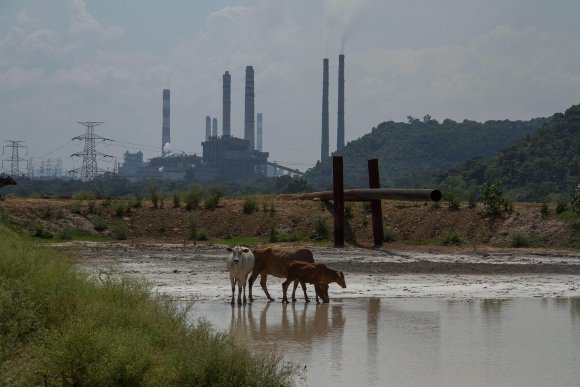
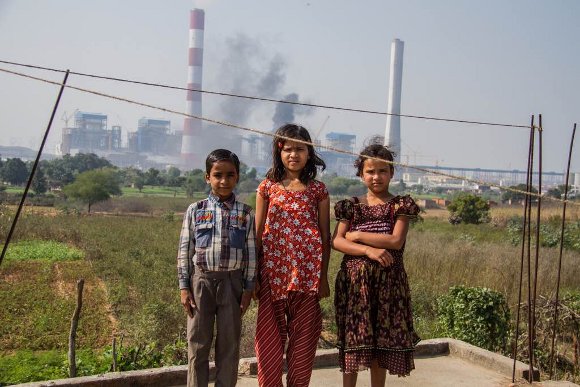
The district is known as the Energy  Capital of India due to proliferation of thermal power plants and coal mines which blot the landscape. It accounts for a full tenth of the country’s thermal power capacity. Emissions and dust from the 1,200 MW Mahan power plant near Lalshah’s home have affected his health, his fields and crops.
The power plant is built by Essar Power, which resumed generating power in May this year after a 17-month hiatus due to people’s protests. Essar received “substantial financing” from two Indian financial institutions, ICICI and IDFC, to build the plant.
The IFC channelled money into the Mahan plant despite claims from the World Bank that it is no longer funding such projects. In 2013, the Bank made history when it pledged to get out of the coal industry for good, except “in rare circumstances.”
After decades of funding coal, the environmental consequences of continuing to do so – catastrophic global climate change, rapid deforestation, air and water pollution – were just too severe, states IDI.
This May, World Bank President Jim Kim was unequivocal in his remarks. Building more coal plants, in particular in Asia, where there has been a boom, would lead to catastrophe. “That would spell disaster for us and the planet,” he said.
According to the report, the World Bank continues to be a major funder of the coal industry, and the ramifications extend far beyond India’s Singrauli district.
It says,”..Billions of dollars in IFC funds have quietly flowed into new coal projects around the world through multi-layered financial transactions that exist beyond the scrutiny of the public. The IFC is funding coal through its highly opaque support for commercial banks and private equity funds. These financial intermediaries received $40 billion in IFC funding between 2011 and 2015. They now represent over half of the IFC’s lending portfolio, a proportion that has steadily increased over the past decade.”
Thanks to the IFC, these financial institutions have gone on to fund many of the largest and dirtiest coal projects and companies in the world. The IFC does not publicly disclose the details of most of these transactions, but IDI was able to follow the trail of money during  months-long forensic investigations.
According to IDI, IFC supported financial institutions have funded at least 41 new coal projects – either the facilities directly or the companies that own them – since the World Bank announced its coal ban in 2013. The investigation tackled only a small portion of the IFC’s sprawling financial-sector portfolio. As such, there are doubtless many more projects yet to be uncovered.
In total, these projects account for 56,137 MW of new coal capacity. Adding fuel to the fire, these projects have also decimated some of the world’s forests. Coal plants, and the mines that feed them, are a leading cause of deforestation globally, further contributing to climate change.
Thermal plants are a major source of pollution. Pic: Joe Athialy
IFC’s support for the Mahan power plant is “a microcosm for how it funds coal around the world”. In 2005, the IFC loaned $50 million to IDFC in order to help meet its “growing needs for disbursements in infrastructure projects as well as to diversify its borrowing sources,” according to publicly disclosed project documents.
The following year, IFC loaned ICICI, a large commercial bank, $150 million to support its “capital requirements to finance growth”.
At the time, IDFC and ICICI were major players in India’s infrastructure and industrial sectors. The IFC loans, and the resulting prestige conveyed by a World Bank Group investment, put them in an even better position to fund the kinds of mega-projects they have been financing for years.
The IFC’s support for the project did not end there. Essar, in need of a source of coal to fuel the plant, entered into a joint venture with Hindalco, owned by the Aditya Birla group, to establish a mine nearby. The companies received approval from the government to establish the project, even though environmental groups warned that the mine would destroy one of the largest and oldest indigenous forests of sal trees.
In addition, Greenpeace found that the mine would displace or otherwise harm 50,000 people who lived in the forest or depended on it for their livelihoods like Lalshah, whose dilemma begins the report. “Without the forest, we would lose our major income source. It would be like living as a dead person,” he says.
In 2011, ICICI was one of four banks to provide an $888 million syndicated loan to Essar Power to build the Mahan coal plant. In 2014, ICICI Bank was one of six banks to provide a $163 million syndicated loan to Essar Power MP Ltd, a special vehicle created by Essar Power to develop the Mahan coal plant.
Also in 2014, when Essar faced cost overruns on the project, it secured another massive loan from five banks, including ICICI and IDFC, for the plant. In total, these two IFC-supported banks provided approximately $1.9 billion in financing to build the Mahan coal plant.
Axis Bank, after receiving a $100 million investment in an infrastructure bond from the IFC in 2014, participated in a $1.5 billion syndicated loan to Hindalco. Yes Bank, another recipient of IFC funding, underwrote $570 million in Hindalco bonds.
The company was free to use the capital from these transactions any way it chose, with no strings attached, including to fund the Mahan mine project.
Mint reported on October 26 that Axis Bank recorded  a 71 per cent rise in quarter-on-quarter bad loans and there was “more pain in store”. Some Rs 7,288 crores of assets had turned bad in the three months ending September. The list of bad debts is “dominated by the power sector, which comprises 41 per cent”.
According to Greenpeace, company representatives began surveying and demarcating land for the mine without the consent of people living in or depending on the forest, a clear violation of India’s Forest Rights Act and the IFC Performance Standards.
Opposition and overcapacity
Local residents quickly organized themselves into a resistance movement.  The situation came to a head in 2014, when activists formed a human chain around a survey team. “We were fighting for our constitutional rights. Our forest was not for sale,” Lalshah said. As a place of spiritual importance, losing it was unthinkable. “Our gods live in that forest,” he said.
Local residents are suffering from the air and water pollution caused by the coal plants. Pic: Joe Athialy
Following the protest, Lalshah and other activists were arrested. He spent 28 days in jail. Despite these setbacks, the movement made an impact. Facing bad press in India and abroad, the government cancelled clearance for the mine – though not the power station - in 2015, only the second time in history that it had done so. It was a major victory for the activists.
The IDI report comes precisely the same month as a Greenpeace India study which reveals that India would be wasting Rs 3.23 lakh crores to build 62 gigawatt (GW) of idle coal power plants by the year 2022.
Overcapacity appears to be endemic and the banks are partly to blame for lending funds to projects which are environmentally and financially unviable.
By contrast, Chinese leaders have called a halt to construction work on 30 large coal-fired power plants with a combined capacity of 17 GW — greater than the UK’s entire coal-powered stations. This unprecedented move indicates just how serious the Chinese authorities are about bringing the country’s coal power bubble under control.
Another 30 large coal plant projects in China, for which transmission lines were already under construction, are being axed. Spending money to complete these unneeded coal plants would have been even more wasteful— it would likely have cost well over $20 billion.
On October 25, Business Standard  reported that the demand for power in India had reached a new low. Some 30 power generating companies which have been contracted to purchase 400 million tonnes of coal from Coal India are sourcing far less. Some were only buying 4 per cent of their commitment and were facing penalties.
The two adverse reports also come at a time when bidders for solar power projects are quoting Rs 4.30 per kilowatt hour (kWh), cheaper than electricity from coal!